Chapter 1: The Untitled Text

The Forbidden Teachings

The Esoteric Code and the Forbidden Books
If you want to understand the cosmic chronology of existence, you have to go beyond the borders of the faccepted canon, into the writings known as "the forbidden books." The aim of this inquiry is to expose the historical and metaphysical truth in full: to understand where everything began, and what happened even before the moment the Book of Genesis describes. Every spiritual law that operates in the higher dimensions, and every primal archetype, is reflected in the end in the laws that run our everyday lives, and takes shape in them.
We'll open this path with a text that has no name. In Codex II of the Nag Hammadi library, there's a work that has no title in the manuscript. Scholars first called it "The Untitled Text," and today it's known as "On the Origin of the World." The library was found by farmers in Egypt in 1945. Its manuscripts were copied in the third and fourth centuries CE, and the works themselves are older. In Chapter Eight we'll come back to this work in depth. Here I'm using it as a gate, because it opens with exactly the question this whole book asks. The text says that everyone, the gods of the world and human beings, claims that before chaos there was nothing. And it announces that it will prove they're all wrong: chaos itself was born from a shadow, and the shadow was born from something that existed before it.
When you approach creation stories and sacred texts, you have to tell apart two layers of understanding. The first is the exoteric layer, the visible one. That's the surface: the simple linear story taught in schools and yeshivas, without going any deeper. The second is the esoteric layer, the hidden one. That's the inner code hiding behind the letters and words, the allegories and metaphors.
The laws of alchemy operate in the hidden layer. Whoever understands them and applies them can go through a deep inner transformation and become what's called a "complete human being." I suggest reading humanity's great scriptures, the Hebrew Bible, the New Testament, and the Quran, as three stages of the same system of principles. The Hebrew Bible, and especially the Book of Genesis, lays the metaphysical foundations and the primary laws of cosmic alchemy. The New Testament shows how this alchemy translates into the story and drama of a human life. And the Quran takes the same laws and gives practical tools for absorbing them at the level of the collective.
This ancient knowledge was once open to anyone who wanted to learn. Many books were deliberately removed from the whole and pushed away, and above all, the institutions of the early church worked with determination to keep them out of the official canon. A large share of them were written by the Gnostics in the first centuries CE. The word "gnosis" means knowing, not believing. I suggest seeing the Gnostics as people who held an advanced inner technology. With it, they could see, communicate with, and directly experience information that doesn't come from the three-dimensional layer, but from the upper and lower dimensions. What they discovered on these journeys and in these visions, they put into writing.
It's important to me to stress this: this chapter, like the whole book, is my personal synthesis. I bring together the ancient Gnostic writings, principles from the world of Kabbalah, modern Theosophy, and Gurdjieff's ideas, to build one coherent picture for independent psychological inquiry. When I quote a text, I'll write "the text says." When I interpret, I'll write "one can read" or "I suggest."
What Happened Before Genesis? The Dimensional Map
The canon opens with the words "In the beginning God created the heavens and the earth." With that, it presents a very late cosmological scenario. Genesis doesn't describe the beginning of things. It's a kind of recap of the previous episodes of the cosmic drama: it starts at the point where the physical infrastructure already exists, and from there dives straight into the human drama. But a whole system of beings, angels, and spiritual forces was operating long before material creation took shape in space.
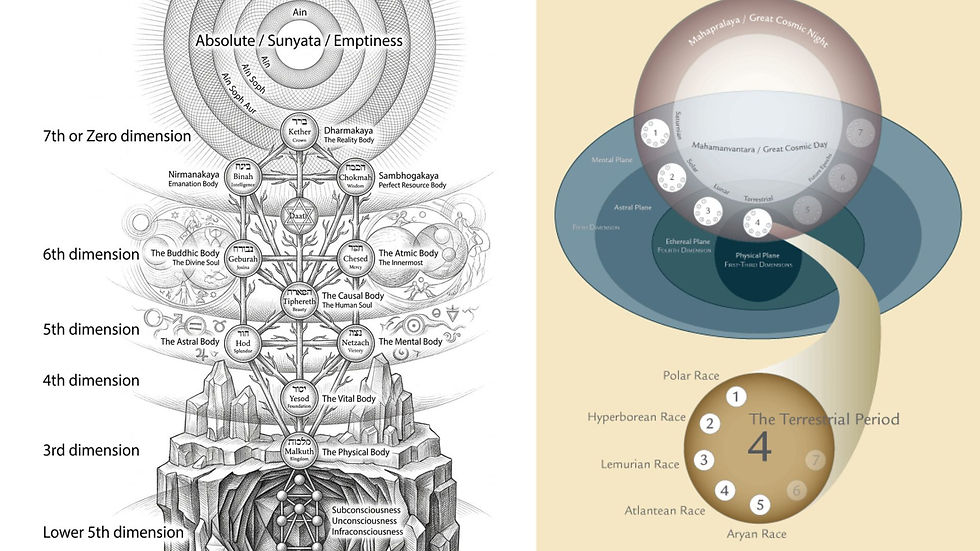
To understand this history from its beginning, I use the map of the Tree of Life, in a Kabbalistic-Theosophical interpretation that combines it with a model of seven worlds of consciousness. It has to be said: this map is my own working tool. You won't find it like this in any Gnostic text. It divides reality into dimensions:
The first through third dimensions: the physical, material layer where we are right now.
The fourth dimension: the layer of time and the etheric dimension.
The fifth dimension: the astral dimension, the dimension of mental formation.
The sixth and seventh dimensions: the dimensions of Creation and Emanation. They're the highest in the system, but they too were built after the fall. They reflect the harmonious order of the Pleroma and imitate it, but they aren't the order itself.
The Pleroma: the world of full, pure light, which lies above the seven dimensions and isn't part of them. Everything emanates from it.
The Gnostic texts describe the same structure in a different language. They speak of seven heavens above the earth, and of their ruler, Yaldabaoth, who sits above them, in the eighth heaven. When twelve rulers appear in the texts, I read them as the twelve stations (signs of the zodiac, or cells) scattered across the seven heavens. And when three hundred sixty-five appear, those are the days of the year. We'll come back to this structure again and again throughout the volume.
The familiar story already starts inside this system, in the seventh and sixth dimensions. From there the information keeps getting denser and heavier, until it reaches the lowest human dramas: Malkhut, the three-dimensional dimension where figures like Jesus or Muhammad appeared. But real inquiry can't settle for a recap. It has to understand what happened up above, in the Pleroma, and what happened in the moment something broke and the seven dimensions came into being at all.
The Cosmic Day and Night
Every cosmic creation takes place within a "Cosmic Day," and you can compare it to a person's day and night. Every night a person goes to sleep. Before sleep, they look back at what they went through, and process the events, the encounters, and the actions. At night the system rests, heals, and processes data. Out of this come insights meant to correct yesterday's mistakes the next day. In this sense, a person is reborn every morning and dies every night. At the far end of the pole of life stands death, and at the far end of the pole of death stands life.
"The Kybalion," an early twentieth-century work that restates Hermetic principles, brings a principle that originates in the Emerald Tablet: "As above, so below." And in a later version: "As within, so without." According to this principle, the same law also operates in the macrocosm. Before any material system forms, the whole universe goes to sleep. It processes the information accumulated over the hundreds of billions of years of the previous Cosmic Day.
In the Cosmic Night, reality returns to a static state with no past, present, or future. The central being is called in the Gnostic texts, especially in The Secret Book (Apocryphon) of John, "the Monad": from the Greek word for one. (And this is my own association, nothing more: the sound recalls "odin," which means one in Russian.) The Monad is the whole before the split. There's nothing outside him. You can't add to him and you can't take away from him, because the moment you add or subtract, he's no longer everything.
In his original, supreme state, the Monad rests in quiet wholeness, without a trace of ego, anger, effort, or intention. But when the split begins and the light emanates downward, into the lower dimensions, a distortion takes place. The further the light descends through the structure, the more wars and inner dramas arise, and as we'll see later in the chapter, this peaks in the fall of Sophia. The splits created in the lower layers are like drops splashing off the ocean. Their job is to experience reality, and in the end to return to the ocean they came from.
The return to unity doesn't cancel individuality. The drops keep existing inside the ocean even as they merge with it. And if a person hasn't completed their dramas and lessons in a given incarnation, they'll come back again and again as a split within the system of cosmic days and nights, and get more chances to set things right. It can feel like an endless, exhausting round on the wheels of karma. But the moment of real liberation, the final exit from the forced cycle of incarnations, comes when the inner light sees the system's illusion and exposes it.
The Cosmic Night is the time when the Monad gathers all the information the souls have accumulated and writes a new code for the next Cosmic Day. And in the same way, night is a psychological state: every person knows it from the inside, when everything stops and waits to be processed. Look at the cycles of day and night in your own life, at life and death, at the seasons, and at the rotations of the stars and galaxies. From them you can also infer the cycles of dimensions and cosmic days. They have to happen. A person reaches the end of their life when their quota runs out, and in the same way, the cosmic days may come to an end in this universe. And still they'll go on existing in many other universes.
Why Perfection Goes Out of Itself
When a new Cosmic Day wakes up, the process starts at the top. The light first emanates into the Pleroma, and there the harmonious order of the Aeons takes shape. The seven dimensions below the Pleroma, from the seventh down to the first, don't exist yet. They'll be built only after the break, and over long ages the information will be compressed through them: into the seventh and sixth dimensions, where it's determined where the galaxies will form; into the fifth dimension, the astral; into the fourth dimension, where time is added; and finally into the third dimension, where the human being carries a material body.
This is where a dramatic difference between human beings appears. Some people manage to awaken consciousness and draw the qualities of the higher dimensions down into the three-dimensional body. And some people stay completely stuck in the material layer, and experience psychological problems, skepticism, and degeneration of the ego.
You can compare this chain of descent to a familiar work process. In the Pleroma the original, abstract code is written: the archetype of every creation. The seventh dimension, built after the break, copies that code, and to a large extent imitates it. The sixth dimension is the strategic plan and the allocation of resources: where planets and galaxies will form. The fifth dimension, the mental-astral one, is the tactical level, where the product takes on an almost final form. And the third and fourth dimensions are the execution itself: the actual doing.
This raises a central question. If in the Cosmic Night everything returns to absolute unity and wholeness, why would that wholeness want to change? Why would it spit out a new Cosmic Day, full of billions of events, suffering, and husks? Why doesn't the universe stay in its eternal rest?
The first answer is the law of the outpouring of abundance. According to this law, the nature of the divine light doesn't allow it to stay static, fixed, or closed in on itself forever. When there's an idea or a primal archetype, it carries a built-in drive to move from potential to actual. The central being of the universe has no ego, so unlike human beings, it doesn't stop itself. Creation ticks like a precise clock.
Think of a creative work you can't stop or hold inside you. A force greater than you pushes you forward, ignoring every distraction and every resistance. That's the force that pushes a musician to compose. By cold logic, no creative work should ever exist. No one should practice for twenty years to play at an amazing level, study theory deeply enough to write a masterpiece, gather musicians, record in a studio, and put the work out into the world.
This drive can't be explained. The great artists didn't set out because of money. They set out because they wanted to bring out the truth and the talent inside them. When you ask them why, many of them talk about an outside force that pushed them. The work had to come out, and it finds its way through whoever is willing to listen. If Einstein hadn't arrived at the theory of relativity, someone else would have reached the same insight around the same time.
I also have a hypothesis, and I'm presenting it as an open question: it may be that the information of the cosmos, the frequencies, and psychology is stored in water that passes from person to person throughout history. The human body is roughly sixty percent water. So what actually drives us? Some creatures are made of an even higher percentage of water. Who decides for them: the water, or the small percentage that defines the form? And if water really carries memory and frequency, what can we do to purify the water inside us and see gnosis clearly? We'll come back to this in the volumes to come.
The second answer is the divine need to know itself. When the Monad rests in absolute unity in the Cosmic Night, he is perfect. But he can't see his own perfection, because there's nothing outside him to serve as a mirror. The Secret Book (Apocryphon) of John describes this moment in a beautiful image: the Father gazes at his image in the pure waters of light that surround him, and out of that gaze comes his first thought, Barbelo. We'll come back to this in Chapter Three. I suggest reading it this way: for the light to see itself, it needs a space of darkness and of "nothing" to define it. The cosmic light doesn't want to be a small candle in eternal darkness. It wants to spread out and light up the whole room.
And one more point, which in my eyes is decisive: the law of coherence. There are those in modern science who claim that reality came about completely at random out of chaos. But consistent, radical chaos wouldn't allow matter to bond in a stable way. It wouldn't allow single cells, complex cells, and whole biological life that doesn't fall apart every second. In constant chaos, evolution over millions of years simply wouldn't be possible.
True, many things in reality behave chaotically: human psychology, volcanic eruptions, extreme weather. But you can't argue with the order: with the stability of matter over time and with genetic development. This order exists. And if it exists, to me that means reality uses chaos to set events in motion, and order to set biology and meaning in motion. Biological order like this, in humans, animals, plants, and minerals, contradicts the idea of absolute randomness. What we have here is a calculated creation, one that keeps its cohesion along the timeline. And that's exactly what The Untitled Text claims in its first line: chaos didn't come first.
The Monad and the Void: From the Abyss to the Pleroma
To describe the Monad, the Gnostic texts describe him only by what he is not. The Secret Book (Apocryphon) of John says that there is nothing above him, and lists everything that doesn't apply to him: not size, not quantity, not time. The Monad has no human personality. He is an infinite source of existence, with no dimensions, no time, and no separate beings. He's like a beam of light that contains all colors and all possibilities, lying dormant inside it.
From this negation I derive two negations that set the Monad apart from conventional religious ideas. The Monad is neither male nor female. And the Monad doesn't judge, doesn't get angry, and doesn't regret. This stands in sharp contrast to the image of God that often appears in the biblical stories, a god who gets angry, judges, and regrets his deeds. The light of the Monad isn't physical light you can measure in a lab. It's a primal, eternal, unborn awareness that needs nothing outside itself. It's the dormant code of light itself.
And here it's important to be precise, because this is a concept that will stay with us throughout the volume. As far as we're concerned, the Monad is "absolute nothing": there's nothing in him you can grasp, measure, or call by name. And in the same breath he is an archetypal "absolute something": the source every other something is derived from. The Void, the silent abyss, is something else. It isn't the Monad. It's the substrate. And the Gnostic Void isn't just a dark or lacking place. It's a primordial infrastructure of potential not yet realized, a cosmic womb that allows the light to spread, to split, and to give birth to structures within it.
Just as a person needs sleep to live, the Monad needs the Void to act. Light and darkness, something and nothing, are two poles that depend on each other. You can't define good without its opposite, evil. Without nothing you can't understand something, and the other way around. Just as you have to stand in a low place to describe a high one.
When the Cosmic Day begins, unmanifested light meets the vacuum of the Void. It's a tremendous energetic friction: the light presses into the Void, and the Void absorbs the light. What modern physics describes, in its own language and separately, as "dark energy" or "quantum vacuum," I suggest reading on the metaphysical level as a product of this friction. Along this seam the spiritual Big Bang takes place, long before the physical Big Bang. According to science, the physical Big Bang happened about thirteen point eight billion years ago, and it's only the last and lowest stage: a physical repetition of far older events.
The light doesn't build the Pleroma by planning or by divine "speech." It flows out according to the law of emanation: an automatic, effortless flow, like a spring of living water. The primordial light spreads, pushes back the static darkness, and for the first time gives birth to multidimensional movement. This movement is the archetype of the linear time the physical body experiences.
That's how the Pleroma is built, the world of pure light. It's completely full of light. There's no empty space in it, no lack, no suffering, no need, no desire. Everything outside it, including our physical universe, is in the Gnostics' eyes a faded image: a flawed reflection, a shadow of the source.
The Pleroma is built of abstract geometric structures, of gates that separate levels of frequency, and of pillars of light. The Secret Book (Apocryphon) of John describes four great luminaries, Harmozel, Oroiael, Daveithai, and Eleleth, and I suggest seeing them as four gates of light surrounding the source, each with its own role. The Aeons live inside these structures. They are conscious, pure beings, splits of the primordial light into the first forms of self-awareness. They aren't angels with private personalities. They're "living ideas," like truth, life, reason, and understanding. Each Aeon runs an inner kingdom that matches its frequency. They all operate in full sync, in telepathic communication, in an eternal existence with no wear and no aging.
This is the rule to remember: emanation builds the Pleroma. The break builds what lies beneath it.
From Light to Matter: The Fall of Sophia and the Secondary Creator
When the waves of light move too far from the center, they naturally weaken, as with a campfire: the further you move from it, the less light and heat there is. In the higher dimensions the speed is instantaneous. But at the edges the light meets the cold Void, and that encounter slows the frequencies down drastically. Spiritual light, free and flowing, cools, solidifies, and loses its original nature. In the end it turns into heavy, rigid, opaque structures. In other words, physical matter is frozen light, lying dormant.
The first movement out of which matter came is the spiral. That's why the whole material universe turns in constant spiral motion, from the structure of galaxies to the energetic activity of the elements. This movement drives the cosmic processes.
In the synthesis I present, inspired by Gurdjieff, this system operates according to the Law of Seven. It has many cultural expressions: the seven colors of the rainbow (a convention set by Newton), or the seven notes of the Western diatonic scale. According to this model, souls pass through seven great stages in the evolution of consciousness. Blavatsky, in Theosophical literature, called them "seven races," and according to her model, human reality today reflects "the fifth race."
What this means is that human existence is neither accidental nor one-time. The potential of the soul and the archetype of every person were already created in the Cosmic Night, inside the central cosmic computer. The human being split across the dimensions, and has a configuration, an energetic "position," on every layer of the system, from the fourth dimension up to the higher dimensions that define their identity. Spiritual development is really a process of remembering this multidimensional identity.
And yet the Gnostics distinguish between different states of consciousness in humanity. The people of matter (Hylics) operate from a completely material, mechanical consciousness. I suggest seeing them as a mechanism in which the same behavior patterns are duplicated across many bodies, like background characters in a computer game, the NPCs. That's how large groups come about that look, talk, and think the same, without any inner will to open the gates. Between them and the people of spirit (Pneumatics), those whose spirituality is awake, stand the people of soul (Psychics): those who are still undecided and can go either way. In the next chapter we'll get to know all three groups in depth.
And now for the central moment of the Gnostic myth. At the edges of the world of light, the Aeon of Wisdom, Sophia, wants to explore separateness. In some of the works, including The Untitled Text, she is called "Pistis Sophia": Faith-Wisdom. Out of this curiosity she looks down into the dark abyss. The exoteric reading sees here the story of a figure who lost her way. I suggest reading it as an allegory for the imprisonment of light inside the material Matrix.
According to The Secret Book (Apocryphon) of John, Sophia acts alone, without the consent of her consort. Out of this act, outside the Pleroma, at the edge of the darkness, a secondary being is born: the architect of the Simulation of lies. The texts call him by several names: the Demiurge, Yaldabaoth, Saklas, Samael. He rules from the eighth heaven, above the seven heavens, and he is the Creator of Secondary Matter. He built the material world as a closed, compressed system, whose purpose is to trap souls and imprison them in a code that forces negative psychology, fear, and ego on them.
And this is also the answer to the question that opened the chapter. Only after this break were the seven dimensions built. Even the highest of them, the seventh and sixth, are a copy of the harmonious order above, not the order itself.
This is the great secret. The Gnostics claimed that the angry, judging, punishing, regretful god who appears in the biblical stories isn't the true, absolute God, the Monad. He's the secondary creator. And I suggest reading the removal of these books from the New Testament canon, during the period when the church took shape, in the same way: if people knew this, they would stop being afraid. The religious Matrix keeps the masses in a loop of mechanical reading of texts and fear of punishment. It has no real practices and no direct spiritual experience. That's how the masses stay weak and obedient.
Our visible reality isn't run by the supreme God. It's run by a compressed system of laws. And this is where the opening for alchemical inquiry appears. The further energy moves from the source, the more it slows down and solidifies into matter. The spiritual spark is hidden in the human being, and its mission is to open the inner gates, rise above the laws of the Matrix, and return to the ancient memory of the divine ocean.
The Butterfly Allegory and the In-Between Trap
The spark that originates in the Monad is hidden in the depths of every person's soul. The physical body and the material world are ruled by lower forces: the secondary creator, the judging and angry one, and his administrators. And yet the inner spirit is connected by a direct line to the infinite. This primordial curiosity is embodied in the archetype of Prometheus. It's the engine that pushes a person to explore metaphysics and alchemy, and to break free from the narrow perception of the social norm.
To understand this psychological process, look at the life cycle of the butterfly. It has three stages.
Most people are in the caterpillar stage. They move slowly and fool themselves that they're doing spiritual work, but in practice they're chained to the masks of the ego. From the outside everything looks fine, and inside, anger, envy, and fear are seething. They cluster with other caterpillars and don't know they can grow wings.
The chrysalis stage is a stage of turning inward, learning, independent inquiry, and direct experience. Here a person starts to recognize the lies and censorship of the Matrix's systems: education, health, security, and the media. They take a step back and turn inward. This is alchemical preparation, in which the person stands alone facing their traumas, fears, and guilt. The ego will do everything it can to stop this painful process, but without it there's no healing. And this is important: this turning inward isn't an escape from the world, and it isn't detached isolation. You do the hard inner work from a place of sovereignty and personal responsibility, in the middle of life.
And in the butterfly stage, the person comes out of the chrysalis into reality, authentic and free. They realize their spiritual potential and express their art and their inner truth in the world. The wings open only because of the hard work of the chrysalis stage.
Most of humanity today functions as caterpillars dressed up as butterflies. People go to spiritual schools and adopt the information as a new religion. They swap one belief for another the way you change clothes. No one wants to admit they don't know. No one wants to go into the chrysalis, because that step condemns them to social exclusion.
I'm writing this paragraph so you won't take what's written in this book as a new belief. Take it as a possible map, one you can use to understand phenomena and inner experiences. If a chapter has no translation into our psychological lives here on earth, I have no reason to write it. This book presents the "why" of human psychology. Here we'll understand the reason for negative psychology, for disease, and for war. We'll understand the structure we entered and how to read it correctly. Whoever understands the psychology of the secondary creator can predict human discourse and actions. And they also understand why there's no point fighting actions built on distorted foundations.
And notice one more psychological tendency: we create states of waiting. "Waiting" is the most dangerous human plague, and many people prefer to stay in the chrysalis. People set out on spiritual journeys they never come back from. I call this "the in-between trap," because it traps a person in eternal intermediate stages.
You can see it clearly in the business world. People look for another course, another training, another workshop, and fill the wall with certificates. All to put off starting the work. The same thing happens in spiritual schools. They can't bring people to awakening, and they justify the failure with long processes, models, and practices that last years, and sometimes whole lifetimes.
Many times I've looked at the methods of well-known teachers with wonder and confusion at the same time. The wonder is sincere: the theories and practices are very impressive. The confusion comes from the fact that these same teachers lead people by the nose into endless processes of initiation, training, and secret techniques. At some point the students fall in love with the practice itself. They don't want this romantic mechanism to end, like a student who's afraid to go out into the real world.
They read more and more books and supposedly train themselves, but they're afraid to translate the knowledge into action, because action puts belief to the test of results. It's like people who train in martial arts and never step into the ring, because they're afraid the techniques won't hold up. And there are fighters who dare, and discover that the impressive techniques aren't enough to survive a real fight. The same goes for a young business owner who fails for the first time. Only then do they realize they have to sharpen their ability to express themselves to an amazing level, to build connection and trust with people. That failure isn't the end of the road. It's the way out of the chrysalis.
Summary: The Gnostic Path to Inner Sovereignty
At the end of every Cosmic Day, after all the events and dramas, the Monad begins to breathe in. All the lower dimensions collapse into themselves and fall apart. The spiritual sparks of human beings and of the higher beings are drawn back into unity. And the forces of evil, ego, and negative frequencies lose their energy source and vanish into the oblivion of the Void.
In the synthesis I'm building, inspired by Gurdjieff and Ouspensky's model of the laws of the worlds, the more anger, heavy skepticism, and mental degeneration a person accumulates, the more they put themselves under the yoke of more numerous, heavier, and more rigid laws. The lower and denser the state of consciousness, the greater the number of mechanical laws that run the person. And the more a person does psychological work and frees themselves from the ego, the higher they rise through the dimensions, subject to fewer mechanical laws, and the closer they come to the law of the absolute One.
The Gnostic path rejects turning outward, to leaders or religious authorities. Every person is obligated to find the divine dimensions within themselves, and to be the sole Sovereign of their own life. The practical tools, circular breathing, meditation, or practices from the East, are all meant for one purpose: to train the psyche in consistent inner observation and full alertness. They're scaffolding. They aren't the goal, and whoever falls in love with them goes back into the in-between trap.
When a person lives in full awareness, they understand that the physical world is a simulation of lessons, and that their true essence is connected to the infinite. A person trained like this won't break even when conflicts, crises, or world-shaking events arrive, in the moments when masses lose their stability all at once. All the books, theories, and allegories lead in the end to the same station: clearing away the layers of resistance, changing core beliefs, healing the emotional and mental system from trauma, finding inner courage, and knowing yourself.



Comments