Chapter 2: The Cosmology of the Dimensions: The Tripartite Tractate

The Forbidden Teachings
The Library Buried in the Earth
To understand how reality was created, you have to go straight to the sources that were hidden away and pushed out of the canon of the religious establishments. That's the only way to get a complete, uncensored picture. To do that, we'll examine esoteric knowledge that survived the generations and came to light again in the twentieth century.
The pillar of this knowledge is the library found in 1945 at Nag Hammadi in Egypt. It was buried in the ground inside a sealed clay jar. One of the leading hypotheses in scholarship links the burial to the year 367. That year, Archbishop Athanasius of Alexandria sent out a festal letter that officially fixed the list of the books of the New Testament and warned against the external books. The letter didn't order anything to be burned. But one can read in it an act of censorship: it marked everything else as "heresy" and made owning those books dangerous. According to this hypothesis, monks from one of the Pachomian monasteries in the area, who loved these books, weren't willing to get rid of them. They hid them in a jar and buried them, and the jar waited in the ground for more than fifteen hundred years.
Athanasius's letter wasn't an isolated case. Similar acts of censorship and hiding away took place throughout history in other traditions too, with no direct connection to it.
In Judaism the process was more scattered. When the canon of the twenty-four books of the Hebrew Bible was sealed, the Sages left out books like 1 Enoch and Ben Sira. The Mishnah brings the words of Rabbi Akiva: "Even one who reads in the external books" has no share in the world to come. These books weren't burned. People simply stopped copying them, and they disappeared and became lost manuscripts. The Book of Enoch, for example, survived in full only thanks to the Ethiopian church, which included it in its canon. And there were real burnings too. Among the disasters of the Seventeenth of Tammuz, the Mishnah lists the day on which "Apostomos burned the Torah." His identity isn't known for certain, but it's the memory of a foreign ruler who burned a Torah scroll in public. In the thirteenth century, in Paris, after a public trial initiated by the convert Nicholas Donin, King Louis the Ninth, encouraged by the Pope, ordered copies of the Talmud confiscated. Twenty-four cartloads of manuscripts were burned in the city square. And in the eighteenth century, following the disputation with the Frankists, about a thousand copies of the Talmud were burned in Poland.
In Islam, the burning was done in the name of uniformity. Around the year 650, in the days of the third caliph, Uthman ibn Affan, arguments broke out between fighters from Syria and from Iraq over the way to recite the Quran. Different written versions existed, among them the codices of Ibn Mas'ud and of Ali ibn Abi Talib. Uthman appointed a committee that produced one official version, and then ordered all the other copies burned. And for centuries the religious establishment, the ulama, persecuted Sufi mystics who held the hidden interpretation of Islam, the "batin." The famous example is Mansur al-Hallaj, who was executed in Baghdad in the tenth century for statements like "I am the Truth." According to tradition, his writings were also confiscated and burned.
And in medieval Europe, the Catholic Church persecuted the Cathars in southern France, in the Albigensian Crusade of the thirteenth century. The Cathars held a dualistic interpretation of Christianity, close in spirit to the Gnostic one. The church burned their books together with the believers themselves, until almost no trace of them was left.
Most of the works in the Nag Hammadi library were composed in the second and third centuries CE, some date part of them earlier, and the manuscripts that were found were copied later. In that early period, the people called "Christians" held views completely different from the ones we know today, and the Gnostics were among the most prominent currents. As I wrote in the previous chapter, I see them as people who held an inner technology: the ability to enter deep states of consciousness, to communicate with higher dimensions, to draw information from there, and to put it into writing. And I see successors to this path in later generations too, in Helena Blavatsky, Annie Besant, and Gurdjieff.
The Nag Hammadi find includes thirteen codices, ancient bound volumes, containing fifty-two works. They lay out an alternative system of knowledge: a mapping of the dimensions and of the creation stories, alongside an esoteric interpretation of the story of Jesus and of the stages that came before the physical world. Next to them stand other discoveries from the same world: the Dead Sea Scrolls from Qumran, the Codex Tchacos, and Manichaean writings discovered in China and Egypt.
The Tripartite Tractate and the Dimensional Map
One of the longest and most central works in the library is The Tripartite Tractate. It runs for about eighty-eight pages in Codex I. "Tractate" means a theoretical work, a treatise. It comes from the Valentinian current, one of the most sophisticated Gnostic currents, and it's divided, like the cosmic structure it describes, into three parts. The first deals with the Father, the Son, the Church, and the Aeons, and with the break that happened in the Pleroma. The second deals with the creation of the human being. And the third deals with the three kinds of human beings and with redemption. Its aim is to bridge between human understanding and the way the reality we live in came into being.
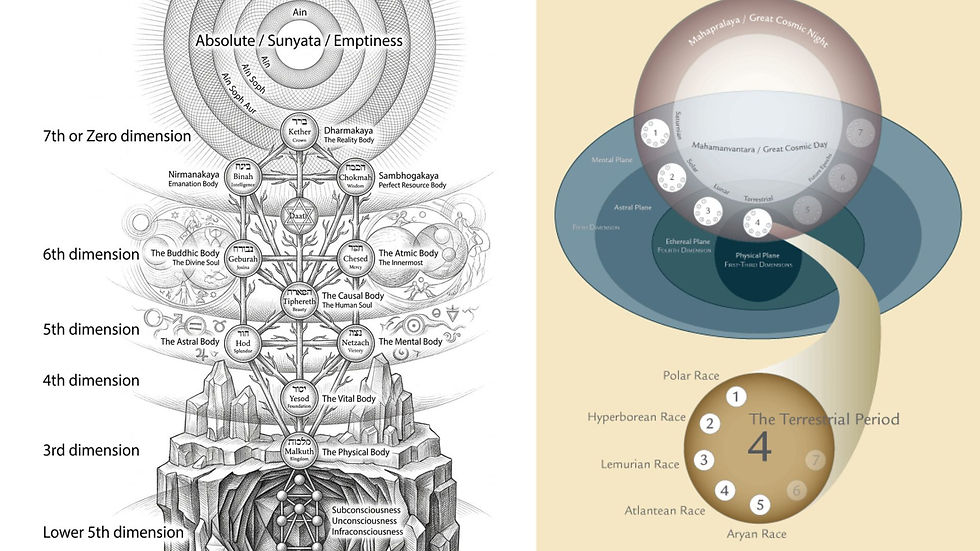
Before we go into the text, let's go back to the map. The dimensional map is my working tool, not part of the work. It divides reality into layers and frequencies:
The first through third dimensions: the physical, three-dimensional world, where we live in a body.
The fourth dimension: the dimension of time and the etheric layer.
The fifth dimension: the astral and mental dimension. This is where a person's thoughts, emotions, and tactics live. They have no form the eye can see, but they're completely real and they steer our lives. Thoughts, which are built in the brain as networks of neurons, eventually take shape in the physical layer through hormonal activity and the endocrine glands. And at the same time, I suggest, they radiate mental matter that prepares the physical manifestation. That's how people summon their own reality.
The sixth and seventh dimensions: the dimensions of organization, strategy, and archetypes. They're the highest in the system, but like all seven dimensions, they were built after the fall. They copy the harmonious order of the Pleroma; they aren't that order.
I read these seven dimensions, in Kabbalah, as the Tree of Life, and in the Gnostic texts as the seven heavens, above which, in the eighth heaven, Yaldabaoth rules. This whole structure is part of the Matrix, not of freedom. And below the physical world stretch the layers of the subconscious, the underworld, which various traditions, Dante first among them, described as nine circles of hell. I read them as a map of a person's psychological flaws and of the arenas where the ego operates.
The Tripartite Tractate takes us beyond all of this: to what existed before the seven heavens, in absolute harmony. To the Pleroma.
The Silence Before Creation
Before all matter, and before all movement, the whole of reality rests in the Cosmic Night.
As we saw in the previous chapter, a person goes to sleep, the body rests and consciousness processes data, and in the morning they get up to a new day. The universe works the same way, in cycles of cosmic days and nights. One Cosmic Day lasts hundreds of billions of years, and at its end the whole system goes back into the night, into rest.
In the Cosmic Night, reality is a vast, unlimited space of consciousness. There's no time in it: no yesterday and no tomorrow, only an eternal, continuous present. There are no physical boundaries in it. If we try to imagine it, we won't see beings with bodies, but abstract, shifting geometric clusters that carry within them the dormant code of everything.
It's a space of absolute silence. The Valentinian current even gave this silence a name, "Sige," and placed it beside the first source. But this silence isn't emptiness, and you mustn't make the mistake of seeing it as zero. I suggest reading it this way: all the codes of reality are already written in it, in a static state. All the words, thoughts, and sounds that will ever be heard are already there, ready. They just aren't running yet. The silence is the whole cosmic potential, compressed with such high energy that it carries an unavoidable drive to burst out at the dawn of the next Cosmic Day.
When the night ends, the Monad begins to project himself outward. Here we need to be precise again, as in the previous chapter: as far as we're concerned, the Monad is "absolute nothing," hidden and concealed, with nothing in him that can be grasped. And in the same breath he is an archetypal "absolute something," the source of every something.
The Tripartite Tractate describes the first projection as a triad: the Father, the Son, and the Church.
The Father: the concealed source. The text describes him as one who has no beginning and no end, one who can't be named or grasped.
The Son: the Father's first thought about himself, the reflection in which the Father sees himself for the first time.
The Church: the totality of the Aeons, who are born from the mutual love of the Father and the Son.
Notice: in the familiar Christian trinity, the Holy Spirit stands where the Church is. And here I suggest reading a parallel, which is mine and not the text's, to three levels that Kabbalah calls Ayin, Ein Sof, and Ein Sof Or. I also suggest seeing in this threefold structure a pattern that exists before the familiar triads and beyond them: Keter, Chokhmah, and Binah in Kabbalah, and Brahma, Vishnu, and Shiva in India.
The mechanics of the split come from the Father's need to know himself. In his static state he can't see his own essence, and to know himself, duality is required. The moment the Father looks inward and thinks his first thought, the thought takes shape and becomes the first being: the Son. In The Secret Book (Apocryphon) of John, as we saw, Barbelo takes this place. The language is different, but the moment is the same: the light sees itself for the first time.
This triad doesn't belong to the secondary, limited creation of the Demiurge, who rules it from the eighth heaven. On this layer, emanation experiences itself as pure, eternal existence. The Aeons live in the Pleroma as one harmonious network of consciousness. Each Aeon is an octave of information and frequency, with no selfishness, envy, or ego.
The Spiritual Church and the Secret of the Horos
The move from thought to action follows what I call the law of grace, or the law of overflowing grace. The tractate returns again and again to the goodness of the Father and to his generosity: he keeps nothing for himself. His light doesn't act out of effort, demand, or need. It flows out on its own, like a spring of living water, and that is exactly the law of the outpouring of abundance we met in the previous chapter. Out of this abundance, the light pours itself downward, to allow beings and frequencies to exist, to take shape, and to express a harmonious symphony.
In the Pleroma, the spiritual Church is built. It isn't a stone building with a cross on the roof. It's the energetic totality of all the sparks. And I suggest reading it this way: before the dense dimensions and the physical bodies came into being, all souls existed together as one collective consciousness, alive and breathing, in the womb of light of the Pleroma.
For the light to express itself in all its depth, this collective consciousness splits into beings and sub-frequencies. The Gnostics called these splits Aeons. Each Aeon is a unique ray and a conscious being, with its own thought, its own color, and its own sound, and together they make up the cosmic choir of existence.
But when unity starts to split into multiplicity, a problem arises. If an Aeon comes too close to the core of the Father's light, the infinite power will dissolve it. Its uniqueness, identity, and frequency will be erased, and it will be drawn back into the primordial ocean without experiencing the drama of creation.
The Horos solves this problem. The concept is known mainly from the Valentinian tradition, to which The Tripartite Tractate belongs, and in Greek it means "boundary." The Horos isn't a god in human form. It's a protective boundary, an energetic envelope, a hidden seam. It has a double role: it separates the core of the Father's light from the Aeons, and it protects them from the excess power of the source. That way multiplicity can exist inside unity without dissolving.
The Horos is, in fact, the guardian of every soul's sovereignty. It ensures that every unique frequency created above keeps its identity. This is exactly what we saw in the previous chapter: the return to unity doesn't cancel individuality. The drop stays a drop even inside the ocean, because there's a boundary that protects it. And this boundary is also the stage for the first drama: the moment the light oversteps it, and out of that overstepping the laws, dimensions, and worlds are created through which souls will make their great journey.
The Error of the Logos and the Birth of the Shadow
The Aeons come into being in the Pleroma without effort, as a consciousness that expands on its own. But the Cosmic Day also carries a built-in potential for crisis. And the crisis doesn't come from an outside force or from evil. It comes from an inner drive of the last Aeon, the youngest in the chain: the Logos. In The Tripartite Tractate, the Logos fills the role that Sophia fills in other works, like The Secret Book (Apocryphon) of John. The name changes, and the pattern stays.
The Logos is driven by an intense desire to understand the Father, to know the source, and to be the closest to him of all. But he tries to do it alone: by the power of his own private will, without a partner and without harmony with the other Aeons. The text says that he acted out of great love, and that is the root of the first error of this Cosmic Day. And there's an amazing detail here: the text insists that this movement wasn't against the Father's will. It had a place in the plan. I suggest reading it this way: the break, too, is part of the law of the outpouring of abundance. Without it there would be no drama, and without drama the light wouldn't know itself.
An attempt by a single mind to contain the infinite leads to collapse. When a being tries to grasp something greater than itself, its system "crashes." And when you translate this into human psychology, you recognize exactly the same mechanism: when a person faces an event or a frequency too big for them to contain, their frequency drops immediately into doubt, fear, guilt, and anger. On the cosmic level, the excess energy that didn't find its place in the harmony is forcefully expelled beyond the boundary of the Horos.
When this excess crosses the boundary, it falls into the Void, into the primordial abyss. This is the turning point where the defect, the deficiency, is born. Energy that was part of a full world, with no lack or need, suddenly finds itself outside the protection of the Pleroma: in lack, in confusion, in fear, and in total forgetfulness of the source. The expelled light changes its form. The direct connection with the Father is lost, and in its place a psycho-energetic engine is created that feeds on the feelings of lack and doubt of the broken Logos.
This is where the reality that humanity is trapped in today begins, the one the Gnostics didn't see as a real world. The real world, the world of wholeness and light, is somewhere else entirely. The lower space is a simulation born from that break.
Out of the break, a new layer of existence is created: the world of shadow. The text speaks of "likenesses" and "images" of the higher beings, which were created without a direct connection to the source. The further the flawed light moves from the Pleroma, the denser it gets. Spiritual energy slows down, cools, and solidifies. The shadow turns into low archetypes and codes, and they keep compressing until they form the physical world. Matter, rigid and heavy, is compressed light lying dormant, shut inside a metaphysical box.
Only at this stage are the seven dimensions of the Tree of Life built, the infrastructure of the Matrix. These are the dimensions we know today as the accepted layers of creation, but they were built as a secondary, closed system, out of the darkness and the compressed matter, to run the world of shadows. If the Logos had projected his light in harmony with the other Aeons, the heavens would have been created out of love, freedom, and abundance.
The Architecture of Enslavement: Right, Left, and the Secondary Creator
Out of the deficiency, the doubt, and the forgetfulness of the light expelled beyond the Horos, a new kind of conscious being takes shape. They aren't angels of pure light. They're psycho-energetic forces called the Archons, from the Greek word for "rulers."
The Archons aren't flesh and blood. They're energetic structures born from the break. Their role is to run the seven dimensions of the Matrix. They wove the fishermen's net of the universe: a rigid system of laws that traps consciousness inside fate, causality, and linear time that repeats itself. Their goal is to control the sparks, to enslave them to matter, and to imprison souls in a loop of incarnations, samsara. They do it by constantly feeding fear, lust, guilt, and anger.
The Tripartite Tractate divides these forces into two camps: those of the right and those of the left. And I suggest seeing these two camps reflected precisely in the political and social structures of our world.
According to the text, the forces of the right were born from the memory and the remorse of the Logos, from the drive to restore order. I see them running the worlds of religion, the establishments, law, traditional politics, and academia. They shackle consciousness with external laws, dogmas, mechanical rituals, and a spiritual bureaucracy that sends souls back into more and more incarnations of correction under the yoke of guilt and awe.
The forces of the left were born, according to the text, from the passion and the impulse of the Logos, and from the love of control. I see them representing the law of the jungle: brutal energy, selfishness, and the blind pull toward matter, without any inner morality.
At the top of the pyramid stands the secondary creator, the chief engineer of the Simulation: the Demiurge. The Tripartite Tractate doesn't call him by name, and presents him relatively gently: the Logos uses him like a hand, to arrange the lower world. But in the other works we'll meet throughout the volume, he appears under his names, Yaldabaoth, Saklas, and Samael, and with a much harsher face. He is the Creator of Secondary Matter, and he rules from the eighth heaven. He was born in the darkness outside the Pleroma, and because of his ego and blindness he can't see anything beyond his own kingdom. He's sure he is the only god, and there is none besides him.
Out of this ignorance, he declares himself a judging, jealous, angry god. I suggest seeing him as the god who emerges from the simplistic reading of the biblical stories, and of the religions built on them: a god who demands obedience and worship, and hides from humanity the existence of the free source, the Monad. That way people stay weak, frightened, and cut off from their inner authority.
And yet, the Matrix is sealed, but the drama doesn't abandon the trapped sparks. When the Logos understands the depth of the break, he turns back and prays to the Pleroma. The tractate describes the answer: the Son goes out from the Pleroma as a savior, and with him seeds of light are sown. This remorse, which in human beings translates into guilt and conscience, gives birth to a rescue operation.
The Logos can't erase the world of matter without destroying his own energy. So the rescue works quietly: seeds of pure light from the Pleroma are inserted into the physical bodies of the Matrix. It's a cosmic commando operation. And the person who wakes up in the world of matter becomes a double agent. On the outside, they live in a body, subject to the laws of nature, economics, and society. And inside, in the depths of the soul, a spark is planted in them that doesn't belong to the Demiurge. If they fall asleep, they're drawn completely into the games of ego and matter. If they wake up and recognize the Simulation, they set out on the journey back home: an inner process that loosens the Archons' grip and prepares the ground for the collapse of the whole system.
The Three Levels of Consciousness
The third part of The Tripartite Tractate comes to the human being. Human beings, so it says, aren't all made of one piece. They divide into three kinds, according to the layer that runs their lives: matter, soul, or spirit.
The people of matter (Hylics). At the base of the pyramid are those who live in a completely material consciousness. Their spark lies in an especially deep sleep, and they operate in the Simulation on autopilot, like what the gaming world calls NPCs: characters without a player. They identify completely with the body, with the mechanical mind, and with basic survival needs.
I see them driven by the forces of the left: chaos, instincts, survival, and the blind pursuit of money, property, power, honor, and lust. There's no inner intention in them, no independent thinking, and no drive to investigate the truth. They repeat the same clichés, obey the media and the establishment without questioning, and react to life events in a mechanical, preprogrammed way. The text says that the people of matter will perish together with matter. And I read it this way: at the moment of death, their consciousness is immediately drawn back, mechanically, into the wheel of incarnations, without any understanding of the process.
The people of soul (Psychics). On the second level are those who have developed intellect, emotion, morality, and conscience. Matter alone doesn't satisfy them. They search endlessly for meaning, divinity, and order. And their failure is that they always look for all of these outside themselves. I see them driven by the forces of the right: order, establishments, and doctrines. These are the people of the book and of religious law, the rabbis, the priests, the judges, and the people of academia and establishment science. They need rigid systems of laws, customs, and rituals to feel safe, and their main motive is fear of the angry, judging god, the Demiurge.
The tractate gives the people of soul an intermediate status: they can lean either way, and redemption is open to them. But many of them stay imprisoned in the religious and political Matrix, and sometimes they swap material enslavement for an imaginary spiritual enslavement: people-pleasing, chasing powers, external visions. Many of them develop the ability to hear and see multidimensional information, and they're sure it comes from the absolute light. In my view, in practice it reaches them through the seven dimensions of the Matrix.
The people of spirit (Pneumatics). At the top are those in whom the spark that originates in the Monad has woken up and become the driving force of their lives. They experience gnosis: direct experiential knowing, pure intuition, and contact without intermediaries with the dimensions of light. They don't need religious establishments, churches, synagogues, rabbis, teachers, or books to dictate to them what's allowed and what's forbidden. They know the laws of creation from their own inner compass.
They act from inner intention and from sovereignty. They don't wait for approval from those around them. They process their inner world deeply, and bring their creation and their truth into action, in a tangible way. The Archons can't run these people, because their consciousness has already been weaned off matter and off the laws of fate and karma of the Simulation. They move through the world as free agents, and draw the frequencies of the Pleroma into dense reality.
The True Apocalypse and the Breaking of Karma
The history of matter and the Simulation doesn't go on forever. Just as the Cosmic Day opened out of the outpouring of abundance, it will close when the Monad's "breathing back in" operates at full force. What the institutionalized religions describe with terror as the End of Days or the Day of Judgment, The Tripartite Tractate describes as a return: everything goes back to the place it came from. And I read it as a natural, blessed process of dismantling and of healing.
The engine of this change depends directly on the degree to which human beings wake up. The more souls wake up, recognize the lie of the Archons, and free themselves from the psychological code of matter and religion, the more seeds of light are gathered. The sparks that have woken up reunite into the one collective being: the spiritual Church of the Pleroma.
When a critical mass of sparks wakes up and leaves the material layer, the pyramid of control will lose its energetic base. With no light to feed them, the Archons and the Demiurge will be left cut off from the source of abundance. The physical universe will gradually start to come apart. The forces of evil, the games of ego, fear, and chaos will evaporate into the oblivion of the Void. And the souls that did the work, that went through the school of suffering, will cross the boundary of the Horos and return to live in the world of light of the Pleroma.
But the correction doesn't happen on its own. It demands real action in the physical world. You can't settle for sitting passively, for countless books, or for more and more courses and seminars, without tangible steps in everyday life. The path to freedom requires a person to become the Sovereign of their own reality.
One of the great obstacles on the way is the "secondary redemption" of the religious Matrix. Many of those who do psychological or spiritual work stop at the soul stage and swap one establishment for another: spiritual festivals, drug ceremonies, worship of new teachers. This is the in-between trap from the previous chapter, in new clothes. A clear warning emerges from the Gnostic writings: every turning outward, every search for a solution from other beings, leaders, or systems, keeps a person trapped in the laws and the fate of the Archons, and brings them back again and again into the cycle of incarnations.
To break karma, a person has to enter the chrysalis stage. This is turning inward, not escaping the world: the person goes on living in it, but disconnects from social norms, from the definitions of the Matrix, and from the power games of the ego. Inside the chrysalis the real work gets done: clearing the seven passages and the seven energy centers of the body; deep healing of past traumas, of the fears, the guilt, and the shame that were implanted in the system; and developing full independence, on the psychological, mental, economic, and social levels. Only from inside the chrysalis can you recognize the lie and the illusion of human karma.
Summary: Gnosis as a Technology of Alertness
All the practical tools, the alchemical techniques, the breathing exercises, the meditations, and the psychological practices are ultimately meant for one purpose: to train consciousness to live in continuous inner observation, in full alertness, every hour of the day. They're scaffolding. They aren't the building.
A person who lives in full alertness understands the "how" and the "why" of existence. World events, political crises, and media manipulations no longer set them off. They act from inner knowing. And as we saw in the previous chapter: the more a person peels away the layers of the ego, the fewer mechanical laws run them. They free themselves from the yoke of the laws of matter, and submit themselves to the law of the One.
And at this point, the spark in the person wakes up fully. They become the butterfly that spreads its wings and comes out of the chrysalis. They're no longer a slave of the Matrix. They're the Sovereign of their own life: an agent of light who has cracked the code, healed their system, and knows exactly how to make their way back home.


Comments